Should your business invest in a professional website or a mobile application? This is an important question for startups, entrepreneurs, and established companies planning their digital growth. Both websites and mobile apps offer valuable benefits, but they serve different purposes and require different investments. In this guide, we'll compare websites and mobile applications in terms of cost, accessibility, customer engagement, marketing, and long-term growth to help you choose the right digital solution for your business.
Website vs Mobile App: Which Is Better for Your Business in 2026?
In today's digital economy, businesses need effective ways to connect with customers, promote their services, and deliver convenient experiences.
Two of the most common digital solutions are professional websites and mobile applications.
Although both can support business growth, choosing the wrong solution may lead to unnecessary development costs, limited customer engagement, or missed opportunities.
So, should you build a website, develop a mobile app, or invest in both?
Let's explore the differences and discover which option makes the most sense for your business.
1. What Is a Business Website?
A business website is an online platform that customers can access through a web browser using a domain name.
Websites can provide information, display products, accept inquiries, process orders, and offer digital services.
Common types of business websites include:
- Corporate websites.
- E-commerce stores.
- Service websites.
- Online booking platforms.
- Educational websites.
- Customer portals.
- Web applications.
Benefits of a Business Website
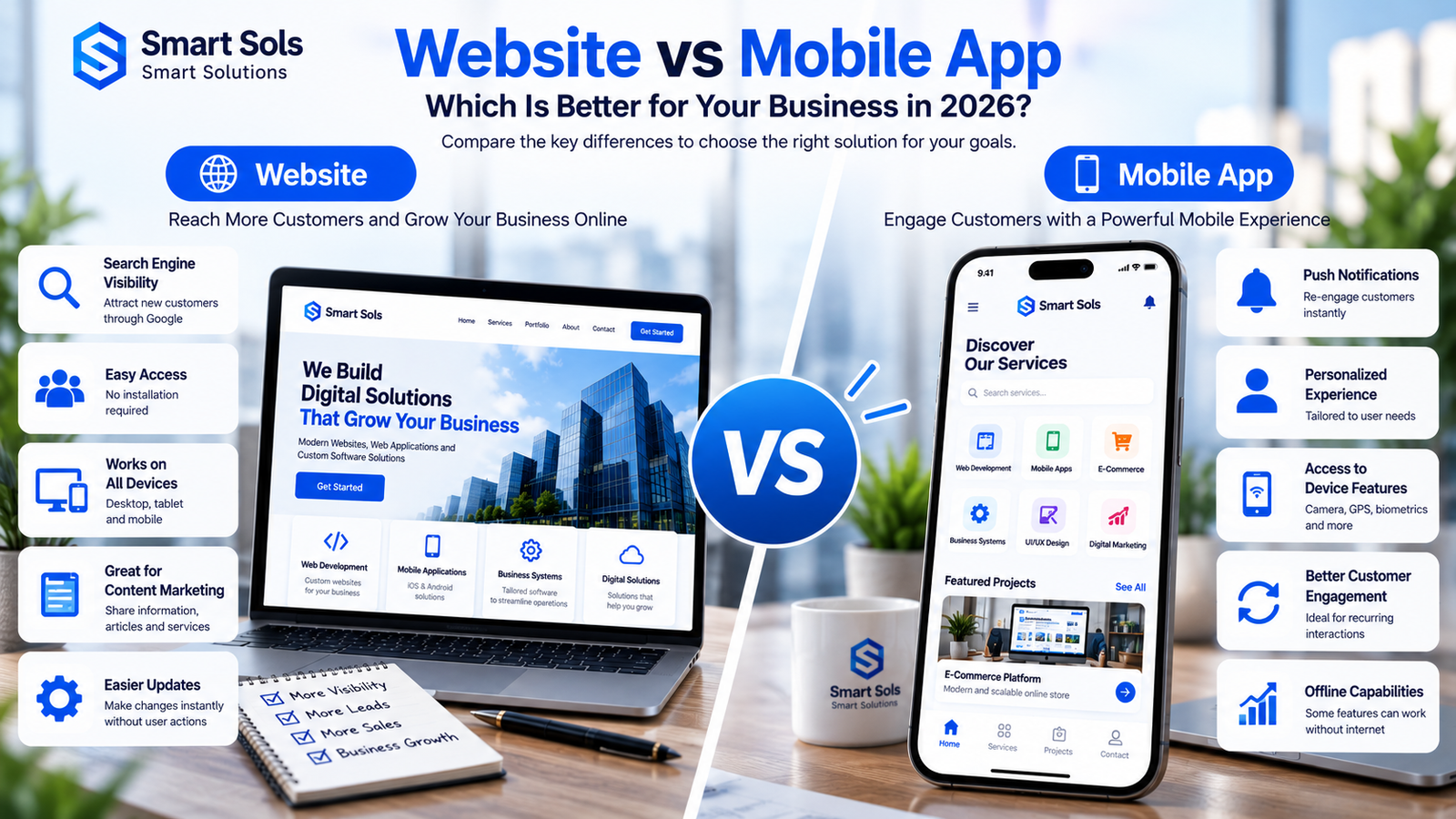
Easy Accessibility
Customers can visit your website directly through a browser without installing additional software.
Search Engine Visibility
Websites can attract potential customers through search engines such as Google when they are properly structured and optimized.
Cross-Device Compatibility
A responsive website can work across smartphones, tablets, laptops, and desktop computers.
Content Marketing Opportunities
Businesses can publish articles, service pages, case studies, and educational content to attract relevant audiences.
Flexible Updates
Website content and many features can be updated centrally without requiring users to download a new application version.
2. What Is a Mobile Application?
A mobile application is software designed to run on smartphones or tablets.
Apps are commonly distributed through platforms such as Apple's App Store and Google Play, although other distribution methods may also exist.
Mobile applications can provide specialized functionality, personalized experiences, and access to certain device capabilities.
Examples include:
- Shopping applications.
- Food delivery applications.
- Banking applications.
- Fitness applications.
- Customer loyalty applications.
- Business productivity applications.
- Appointment booking applications.
Benefits of a Mobile Application
Personalized User Experience
Applications can offer personalized dashboards, saved preferences, and experiences tailored to individual users.
Push Notifications
Apps can send notifications, subject to user permissions, to communicate relevant updates and reminders.
Device Integration
Mobile applications can access supported device capabilities such as cameras, location services, and biometric authentication with appropriate permissions.
Offline Capabilities
Certain application features can work without an internet connection when designed to support offline use.
Customer Retention Opportunities
Apps can support loyalty programs, repeat purchases, and frequent customer interactions.
However, these benefits depend on the application's design, usefulness, and customer adoption.
3. Website vs Mobile App: Key Differences
Understanding the practical differences between websites and mobile applications can help you make a better investment decision.
| FeatureBusiness WebsiteMobile Application | ||
| Accessibility | Through web browsers | Usually requires installation |
| Search Visibility | Can attract organic search traffic | Primarily discovered through app stores and marketing |
| Development Cost | Often lower for basic requirements | Often higher for comparable basic functionality |
| Updates | Usually deployed centrally | May require app store releases |
| Push Notifications | Possible in supported environments | Broadly supported with permissions |
| Offline Access | Possible with appropriate technologies | Can support offline functionality |
| Device Features | Access varies by browser and platform | Often offers deeper platform integration |
| Customer Engagement | Suitable for discovery and transactions | Particularly useful for recurring interactions |
| Maintenance | Website and hosting maintenance | App, backend, platform, and store maintenance |
These are general differences rather than universal rules. Modern web technologies can provide some capabilities traditionally associated with mobile apps.
4. Which Option Costs Less?
Cost is one of the main factors businesses consider.
For a relatively simple online presence, a website often requires less development work than building and maintaining dedicated mobile applications.
However, the final cost depends on functionality rather than the platform name alone.
A complex web application can cost more than a simple mobile app.
Website Development Costs
Website pricing depends on:
- Number of pages.
- Design complexity.
- Content management requirements.
- E-commerce features.
- Third-party integrations.
- Custom functionality.
- Security requirements.
Mobile App Development Costs
Mobile application pricing depends on:
- iOS and Android requirements.
- Native or cross-platform development.
- Number of features.
- UI/UX design.
- Backend infrastructure.
- Integrations.
- Testing and deployment.
Consider Long-Term Costs
Both websites and apps require maintenance.
Mobile applications may also require ongoing compatibility testing, store compliance updates, and platform-specific changes.
Instead of comparing initial prices alone, evaluate the total cost of ownership over several years.
5. Which Is Better for Attracting New Customers?
For many businesses, a website is an effective starting point for customer acquisition.
Potential customers can discover websites through:
- Google Search.
- Google Ads.
- Social media.
- Email campaigns.
- Referral links.
- Online directories.
A website also allows visitors to explore your business without installing an app.
Mobile apps can attract new users through app store discovery and advertising, but installation introduces an additional step.
For businesses focused primarily on generating new inquiries, a well-designed website may be the more practical first investment.
6. Which Is Better for Customer Engagement?
Mobile applications can be particularly valuable when customers interact with a business frequently.
For example, a customer may use an app to:
- Track orders.
- Manage bookings.
- Receive notifications.
- Access loyalty rewards.
- Save preferences.
- Communicate with customer support.
However, an app does not automatically create customer loyalty.
Users must have a compelling reason to install and continue using it.
For occasional interactions, a mobile-friendly website may provide a more convenient experience.
7. When Should Your Business Choose a Website?
A website may be the best starting point when:
- You are launching a new business.
- You need to establish an online presence.
- You want customers to find you through search engines.
- You primarily need inquiries or quotation requests.
- Your services do not require frequent customer logins.
- You want to publish educational or marketing content.
- Your initial budget is limited.
For example, a consulting company may benefit more from a professional website with detailed service pages and contact forms than from a dedicated mobile app.
8. When Should Your Business Choose a Mobile App?
A mobile application may be appropriate when:
- Customers use your service frequently.
- You need push notifications.
- Your service relies heavily on smartphone functionality.
- Users need personalized accounts and recurring interactions.
- Offline functionality is important.
- Your business model depends on a mobile-first experience.
For example, a delivery business may benefit from a mobile app that supports order tracking, notifications, and repeated purchases.
The decision should be based on real customer behavior and business requirements.
9. Can Your Business Benefit from Both?
Yes. Many businesses use websites and mobile applications together.
A website can attract new customers through search engines and digital marketing.
A mobile app can provide a convenient experience for existing customers who interact with the business regularly.
Example: An E-Commerce Business
Website:
- Attracts search traffic.
- Displays products.
- Supports online purchases.
- Publishes marketing content.
Mobile App:
- Provides personalized shopping experiences.
- Supports loyalty programs.
- Sends relevant notifications.
- Simplifies repeat purchases.
Both platforms can connect to the same backend services, depending on the system architecture.
This approach can create a consistent experience across digital channels.
10. What About Progressive Web Apps (PWAs)?
A Progressive Web App is a website enhanced with technologies that can provide certain app-like capabilities.
Depending on browser and device support, PWAs may offer:
- Installable experiences.
- Offline access to selected content.
- Push notifications.
- Faster repeat visits through caching.
- Responsive interfaces.
PWAs can be useful when businesses want to combine website accessibility with selected application features.
However, support for particular capabilities varies across browsers and operating systems.
A PWA is not necessarily a complete replacement for a native mobile application.
11. How to Make the Right Decision
Before investing in development, answer the following questions:
- What business problem are we solving?
- Who will use the platform?
- How frequently will customers interact with it?
- Do users need special smartphone features?
- Is search engine visibility a priority?
- What is our development budget?
- What maintenance costs can we support?
- Can we launch a smaller version first?
- Will the solution need to integrate with existing systems?
- How will we measure success?
These questions can help determine whether a website, mobile application, or combined solution is the most appropriate choice.
12. Common Mistakes Businesses Should Avoid
Businesses sometimes make digital investment decisions based on trends rather than actual requirements.
Common mistakes include:
- Building an app without validating customer demand.
- Choosing technology before defining business goals.
- Underestimating maintenance costs.
- Ignoring mobile website usability.
- Developing too many features before launch.
- Neglecting security and privacy.
- Failing to plan for future integrations.
- Assuming an app automatically increases sales.
The right digital product should solve a meaningful problem and support measurable business objectives.
Conclusion
There is no universal winner in the website versus mobile app debate.
A professional website is often an effective choice for businesses that need online visibility, customer acquisition, and accessible information.
A mobile application can provide additional value when customers require frequent interactions, personalized functionality, or deeper integration with smartphone features.
For some businesses, using both platforms creates the strongest digital experience.
The most important step is understanding your customers, defining your goals, and selecting technology that supports your business strategy.
Need Help Choosing the Right Digital Solution?
At Smart Sols, we help businesses explore professional website development, mobile applications, e-commerce solutions, and custom software tailored to their requirements.
Whether you need a business website, a mobile application, or an integrated digital platform, our team can discuss your goals and help you identify an appropriate approach.
Visit: https://smartsols.net
Contact Smart Sols to discuss your project and request a quotation.